
This year, Toronto Public Library celebrates 140 years. However, lending libraries have been part of the city for more than two centuries. We preserve rare items on our Digital Archive that showcase the history of these 19th-century libraries in what is now downtown Toronto. A big piece of this history is the little-known forerunner to Toronto Public Library — the Mechanics' Institute. Read on to see these rare items, learn about the history of TPL and find out how the city’s early libraries stack up against those of today.

First lending library
The city’s first lending library, Toronto Library, was a private subscription library, established on December 9, 1810. It was located in the Elmsley House at the southwest corner of King Street West and Simcoe Street.
Unfortunately, the library didn't survive the War of 1812. American troops looted its shelves during the occupation of York (now Toronto) in April 1813. Isaac Chauncey, U.S. fleet commander, later returned two cases of books with a note of apology.

Beginnings of the Mechanics' Institute
Mechanics’ Institutes grew out of the Industrial Revolution in Great Britain. In the first decades of the 19th century, tradesmen ("mechanics") needed specialized training in their respective fields. The institutes met this need with educational opportunities for the urban working class.
On December 24, 1830, a small group of men met at the Masonic Hall on Colborne Street near Church Street to organize a Mechanics’ Institute for the town of York (Toronto), which had a population of 2,860. The Institute's most active founders were Joseph Bates, a watchmaker from England, and James Leslie, a shopkeeper from Scotland. Once established, the Institute was housed in a rented space on the second floor of the Masonic Hall.
When it opened in 1830, the Institute's library comprised 1,300 volumes. Like its counterparts in Edinburgh and London, the facility also promoted education in the arts and sciences by offering lectures and night classes. The annual subscription was seven shillings and six pence, and the library was open every evening to members.

In 1834, the town of York became the City of Toronto and the York Mechanics’ Institute was renamed the Toronto Mechanics’ Institute.
We preserve a copy of the constitution and rules of the Toronto Mechanics' Institute from 1842, which define its purpose as "the diffusion of Scientific and Literary Knowledge." One of the five library rules limited members to borrowing a single book at a time. (Today, you can now borrow up to 50 at a time.)
In 1845, the Toronto Mechanics’ Institute relocated to the upper floor of the new Central Fire Hall on the north side of Court-house Lane (now Court Street), which was west of Church Street between King and Adelaide streets. You can examine the Institute's annual report from 1845 on our Digital Archive.


In 1853, a building site at the northeast corner of Church and Adelaide streets was purchased at public auction from the University of Toronto for $6,529.
Architectural firm Cumberland and Storm designed the building, donating their services. It was an impressive space, featuring a music hall, classrooms and library — ideal for events and a wide range of programs. (Unlike today’s programs at TPL, which are free, attendees paid to attend lectures at the Institute. In some cases, members received free or discounted tickets as part of their paid membership.)


Challenges for the Mechanics' Institute
The new building, which cost $48,380.78, plunged the organization into debt. The Institute relied almost entirely on membership fees, which were set at a low rate, and fundraising events fell short of expectations. To ease its financial programs, the Institute leased out office space. The Institute was only able to take full possession of the building in July 1861.
Money problems impeded the development of the library's collection. Maintaining and expanding a diverse collection directly correlated with the Institute's ability to attract and keep subscribers. By the 1880s, more than 80% of borrowed books were “novels and tales,” which didn't support the original intent of the Mechanics’ Institute. Also, the rules of the library were not enforced for fear of losing members, resulting in theft, damaged books and long overdue books.
The Institute's library committee also faced continual struggles with requests for particular magazines, books and newspapers from subscribers as well demands not to purchase “unacceptable” books such as the works of Jonathan Swift.

Campaign for a free library
By 1882, the Toronto Mechanics’ Institute library held 10,500 books with an annual circulation of 27,000. But, while the city’s population grew, its membership stagnated. The Institute tried different ways to raise money, even renting its reading room walls for advertisements.
John Hallam, a former Lancashire mill hand turned successful wools and leather dealer in Toronto, recognized the need for change. Having been the treasurer of the Mechanics’ Institute, Hallam, who was also a city alderman for many years, was well aware of its problems. His solution was to establish a new institution supported by municipal taxes, which became possible in 1882 when the Ontario Free Libraries Act, modeled on British legislation, passed. It was the first act of its type in Canada.

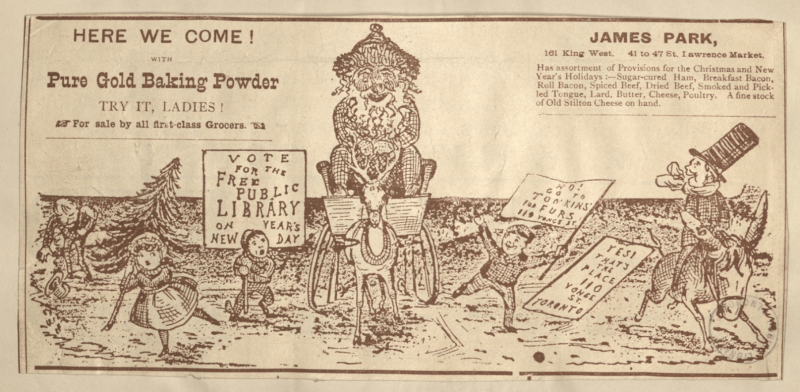
But the provincial act did not guarantee free libraries in Toronto. A bylaw vote on January 1, 1883 was set to determine if Toronto would have a free library system. Hallam campaigned vigorously in favour of the bylaw, but many people disagreed with public funds being used for recreational reading. Newspapers published many letters both for and against the vote.
Ultimately, the bylaw passed 5,437 to 2,932. More people voted on this bylaw than any other previous bylaw in Toronto. The first library board meeting convened in February of 1883. As chair, John Hallam spoke about the aspirations of Toronto Public Library to play a central role in fostering pride in and spreading knowledge about all things Canadian.

The first Toronto Public Library location
Toronto's newly-established library did not have to erect a new building. In March of 1883, the Mechanics’ Institute offered its building, books and other possessions to Toronto Public Library. The offer was accepted and the Toronto Mechanics' Institute ceased to exist.
On March 6, 1884, the 15th anniversary of the incorporation of Toronto, Lieutenant Governor John Beverly Robinson formally opened Toronto Public Library. James Bain, a former bookseller, was chosen by the library board as its first chief librarian. He served in the role until his death in 1908.


Despite renovations prior to opening, the building had limitations. Quarters were cramped and ventilation was bad enough to warrant an examination by the Medical Health Office. Plus, the building had to function as the library “system” headquarters as branch libraries in St. Andrew’s Market (Western Branch) and St. Paul’s Hall (Northern Branch) were opened in February of 1884.
Undeterred by these hurdles, library staff implemented several important services. The acquisition of non-Canadian books in languages other than English began with the addition of books in French and German in 1885, Italian in 1888 and Spanish in 1894. Service to persons with disabilities started in 1895 with the purchase of 70 books in braille. (Today, TPL offers materials in dozens of languages, vital newcomer services and offerings of accessible formats.)


Legacy of the Toronto Mechanics’ Institute
Eventually, Toronto Public Library moved its headquarters in August 1928 to the Downtown Branch at 42 Adelaide Street West. But that wasn’t the end for the former Mechanics' Institute building. It was used during the 1930s as a government aid distribution centre. It was demolished in 1949, making way for a gas station in October 1957. The site is now home to a multi-use building.
The Toronto Mechanic's Institute wasn't the only Mechanics' Institute relevant to our history. Though separate at the time, other Mechanics' Institutes were formed beyond the downtown core: Weston (1858), Scarboro' (1878), Parkdale (1880), West Toronto Junction (1888), Highland Creek (1890) Islington (1890), Don (1896) and Bracondale (1898). Their respective communities are now served by today's 100-branches-strong TPL.
We're fortunate to preserve artifacts from some of these Mechanics’ Institutes as part of our Special Collections. Next time you visit our Marilyn and Charles Baillie Centre of Special Collections on 5th floor of Toronto Reference Library, take a seat at the sturdy table from the Toronto Mechanics’ Institute — a perfect spot to reflect on TPL's long legacy.

More from TPL
Books
- A Century of Service: Toronto Public Library 1883-1983 by Margaret Penman (digitized copy)
- Notes By the Way on Free Libraries and Books, with a Plea for the Establishment of Rate-Supported Libraries in the Province of Ontario by John Hallam (in-person only)
