
Lyn Cook (1918–2018) was a Canadian librarian, storyteller, poet and author of books for children and young adults. We preserve her archive as part of our Osborne Collection of Early Children’s Books. Her fonds (collection of records) holds material related to all aspects of Cook’s professional life, including early writings and two unpublished novels.

Early life
Evelyn Margaret Cook was born on May 4, 1918 in Islington (now part of Toronto). She attended school in a two-room schoolhouse and didn't have access to a library growing up. However, her parents Edward Frank and Emma (Crawford) Cook gifted her books on special occasions.
Cook graduated from Etobicoke High School, where she was encouraged to write by one of her teachers. With the help of multiple scholarships, she attended the University of Toronto where she studied English Language and Literature. She received a Bachelor of Arts in 1940 from University College and a Bachelor of Library Science in 1941 from Ontario College of Education. She was an active member of the University Players Guild.

In 1941, Cook began her professional library career at Toronto Public Library’s Wychwood branch. Located at Bathurst Street near St. Clair Avenue, the building had a children's space known as the Boys and Girls Room. At TPL, Cook's career overlapped with influential children's librarian Lillian H. Smith, the first children’s librarian in Canada.

In 1942, Lyn Cook joined the Royal Canadian Air Force, Women’s Division as a meteorological observer and librarian at age 27. Military records in her archive document her appearance upon joining: five feet and five-and-a-half inches tall, blue eyes and brown hair.
She was based in Centralia and Trenton in Ontario. When she received time off from her duties at the Centrailia airbase, she spent time on a farm near Dundalk, Ontario with her colleagues.
Corporal Cook was honourably released from the RCAF in 1946 at the end of the Second World War. We preserve a speech Cook read at the 50-year anniversary of her service. In part, it reads:
"[W]e served that men might fly but without a doubt we all came with a longing for adventure and new beginnings, and we were rewarded with both in such abundance that our lives were changed forever. In our barrack rooms we became a sisterhood with associations so deep and so meaningful that whenever and whereever we meet we are sisters still."
Sudbury and radio program
After the war, Cook was courted to be a children's librarian by two public library systems in Ontario: Hamilton and Sudbury. She chose to work in Sudbury, becoming the city’s first children’s librarian.


In 1949, Cook married Robb Waddell, the secretary-treasurer of H. J. Motors in Agincourt. They first met when he was working as an aircraft mechanic in Trenton during the war. They raised their son Christopher and daughter Deborah at their home on Cedarbrae Boulevard, Scarborough.

Writing career
Cook’s first novel, The Bells on Finland Street (1950), was inspired by her time in Sudbury. Set in the familiar landscape of Sudbury’s Copper Cliff area, the story follows the daughter of a Finnish miner who dreams of becoming a champion figure skater. The novel reflects the area’s cultural diversity, featuring characters with Scandinavian and other European backgrounds. Cook was inspired to write the story after watching Joyce Salo, Northern Ontario’s 1949 senior ladies skating champion, perform at a winter carnival in Copper Cliff’s Stanley Stadium.

Cook’s books also touch on Canadian history. As she once described it, “I was fascinated with time past, what motivated people." One of the best examples of her historical works is Rebel on the Trail (1953), her third book. In this novel, the Cartwright family visits Toronto and experiences firsthand the Upper Canada Rebellion of 1837. Though some of the names are different and much of the action is fictionalized, many of the characters and events are true.


Cook rose to popularity in the 1950s and 1960s, publishing more than 20 books for children, along with The Brownie Handbook for Girl Guides Canada. Her archive also includes two unpublished novel manuscripts. In addition to her fiction, she wrote poetry under the name Margaret Culverhouse.
Later life
Cook participated in weekly story hours and monthly library presentations at festivals at Bendale branch of the Scarborough Public Library (now part of TPL) from 1962 to 1976. She was also a frequent speaker in schools and libraries.

As an older adult, Cook lived in West Port (near Ottawa) with her daughter Deborah. Later, she was a resident at the Pearly Rideau Veteran’s Health Centre in Ottawa. In 2018, Cook died at 100 years of age. Canadian editor Karyn Huenemann recalled Cook as "a bright, intelligent woman with a sharp sense of humour and a delight in sharing her life and thoughts."
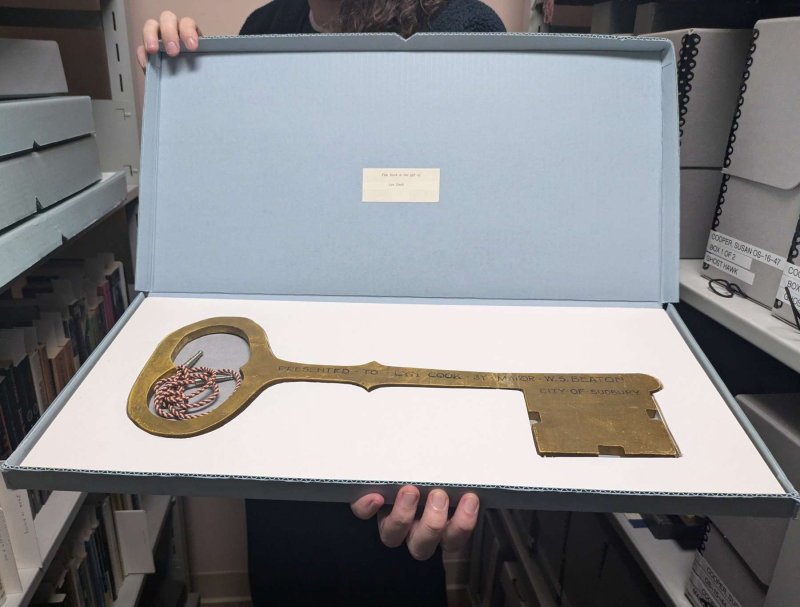
Items that make up Cook's archive were donated between 1991 and 2021, before and after her death, by her and her son. Her archive is carefully preserved in our Osborne Collection of Early Children's Books. Researchers and the general public are welcome to access everything in the archive—from her unpublished manuscripts to a giant key to the City of Sudbury.
Explore more
Blog post written by Pamela
