
Toronto Public Library has a long history dating back to 1883, and was preceded by mechanics' institutes starting in 1830 in York (Toronto). In 1998, seven library boards amalgamated to form the new Toronto Public Library, the largest public library system in North America.
Timeline
-
1810

Elmsley House, home of Toronto Library, 1810–1813 The Toronto Library, a short-lived private subscription library, is founded on December 9. During the American occupation of York in April 1813, the library was looted. In November 1813, Isaac Chauncey (commander of the U.S. fleet) returned two cases of the library's books, with a note of apology to the trustees.
-
1830

York Mechanics' Institute notice in the York Commercial Directory, 1833 York Mechanics' Institute is established "for the mutual improvement of its members in useful scientific knowledge." It included a library for reference and circulation.
-
1834

Toronto Mechanics' Institute diploma, designed by Sandford Fleming, 1850 Town of York becomes the City of Toronto, and the York Mechanics' Institute is renamed Toronto Mechanics' Institute. To educate workers (mechanics), the Institute had a library and offered classes on philosophy, music, science, architectural drawing and more.
Scarboro' Subscription Library is also established. Learn about Scarborough's early library service.
-
1845

Toronto Mechanics' Institute, Court Street Firehall, 1860 Toronto Mechanics' Institute relocates its library and news-room to the upper floor of the new Central Fire Hall (behind the County Court House) on the north side of Court-house lane (now Court Street), west of Church Street between King and Adelaide streets.
-
1858

Weston Town Hall, 1955, location of the Weston Mechanics' Institute (later Weston Public Library), 1885–1914 Weston Mechanics' Institute is established. See also: More history of this Institute.
-
1861

Toronto Mechanics' Institute, 1867 Toronto Mechanics' Institute moves into its new home at the northeast corner of Church and Adelaide streets. Designed by F. W. Cumberland & G. W. Storm, the building contains a library with a reading room, a lecture hall and a large music hall.
-
1870s and 1880s

Campbell Block, location of West Toronto Junction Mechanics' Institute, 1889–1893 Mechanics' institutes with lending libraries and reading rooms are incorporated at Scarboro' (1878), Parkdale (1880) and West Toronto Junction (1888); and revitalized and reorganized at Weston (1885).
-
1882

Campaign card for the free public library, approximately 1882 Free Libraries Act is passed by the Ontario Legislature. Alderman John Hallam leads the Toronto campaign to establish a free public library in Toronto.
-
1883

John Hallam (1833–1900), first chairman of the Toronto Public Library Board, 1883 Free Library By-Law is approved by a huge majority of Toronto voters, January 1. Toronto and Guelph are the first municipalities in Ontario to create free public libraries. John Hallam becomes the first chair of the Toronto Public Library Board.
-
1884

Invitation to the opening of Toronto Public Library, March 6, 1884 Toronto Public Library officially opens in the old Mechanics' Institute building, Church and Adelaide streets, on March 6, the city's 50th anniversary.
Toronto Public Library opens its first two branches, Northern and Western — the Northern Branch is in St. Paul's Hall (formerly Yorkville Town Hall) on Yonge Street. In 1888, another pair are opened, North Western and Eastern. All are in rented spaces.
-
1885

Reference Library staff, approximately 1895 Books in German and French are bought, the beginnings of the library's multi-language collections. Literature in Spanish and Italian is added by 1900, and, to meet the needs of recent immigrants, books in several other European languages are added in the 1910s. See also: Toronto Public Library's services for immigrants, 1908–1937.
-
1887

James Bain Jr. (1842–1908), first Chief Librarian, 1909 Policy to collect Canadiana is established. James Bain Jr., the first Chief Librarian, begins building the library's special collections of publications and manuscripts documenting Canada.
-
1890s

Don Public Library in Aggie Hogg's store, 1925 Mechanics' institutes — renamed public libraries on May 1, 1895 — are formed at Highland Creek (1890) Islington (1890), Don (1896) and Bracondale (1898).
-
1890

Dundas Street Branch, 1901 Toronto Public Library opens Dundas Street Branch in January in rented quarters on today's Ossington Avenue north of Queen Street. It uses furniture and books from the former Parkdale Mechanics' Institute library, annexed to Toronto in 1889.
-
1896

Scarborough Centennial Memorial Library committee, 1896 Scarborough Centennial Memorial Library is built as part of the township's 100th anniversary celebrations.
-
1900s

Runnymede Public Library, York Township, approximately 1912 Public libraries are established at East Toronto (1903), Deer Park (1905), North Toronto (1909) and Runnymede (1909). Toronto Public Library opens College Street Branch in rented quarters at the corner of Brunswick Avenue.
-
1903

Letter offering Carnegie grant, January 23, 1903 Toronto is awarded a Carnegie grant of $350,000 for a new central library (1909–1977) and three branches: Yorkville (1907), Queen & Lisgar (1909–1964) and Riverdale (1910).
-
1909

Toronto Reference Library, College & St. George streets, 1910 Central Library (old Toronto Reference Library) is opened at the northwest corner of College and St. George streets with 97,788 books.
College Street Branch, previously housed in rented quarters at the corner of Brunswick Avenue, is relocated to the basement of the new Central Library; it includes a Children's Room.
Western (now Annette Street) Branch opens. It was built with a $20,000 Carnegie grant to the old City of West Toronto, amalgamated with Toronto in May 1909.
Open shelf system is adopted allowing borrowers in the branches to retrieve books themselves instead of asking library staff.
-
1910

John Ross Robertson with his collection at the Toronto Reference Library, approximately 1912 Toronto Public Library opens branches in storefronts and other rented premises to serve areas recently annexed to Toronto until permanent libraries can be built: Deer Park and Wychwood in 1911; Northern and Earlscourt in 1913, and Beaches and Eastern in 1914. Prior to annexation, some of these areas had their own public libraries.
Donation of the J. Ross Robertson Historical Collection (now part of our Baldwin Collection of Canadiana) firmly establishes Toronto Public Library as a collector of historical Canadian imagery.
-
1911

Municipal Reference Branch, City Hall, 1911 Municipal Reference Library opens in Toronto City Hall. It's the start of special services for civic officials and business people.
-
1912

Lillian H. Smith (1887–1983), approximately 1925 Lillian H. Smith is hired to head Toronto Public Library's new Children's Department, and inaugurates story hours and other innovative services for children. See also: History of Children's Services and Toronto Public Library's services for immigrants, 1908–1937.
Dewey Decimal system of classification is adopted for all books except fiction. Toronto Public Library's Cataloguing Department prepares An Extension of the Dewey Decimal Classification applied to Canada.
1913

Dovercourt (now Bloor/Gladstone) Branch, rendering about 1912 Dovercourt (now Bloor/Gladstone) Branch opens. It is the first library to be financed fully by the City of Toronto.
Mimico Public Library Board is established, opening a Carnegie-funded library in the village in 1915.
-
1914

Weston Public Library, approximately 1915 Weston Public Library Board, established in 1912, opens a Carnegie-funded library in the town.
-
1915

"Overseas contingent in largest military parade ever held in Toronto," 1915 A camp library is established at Exhibition Park for troops training to serve in the First World War. Toronto Public Library is the first library in North America to provide this service for soldiers.
-
1916
-
1918

Library at University Settlement House, 1920s To provide extra service for inner city children, Toronto Public Library opens a library in Central Neighbourhood House. Children's libraries soon are started at other settlement houses: St. Christopher House in 1920, University Settlement House in 1921 and Memorial Institute in 1931. See also: Toronto Public Library's services for immigrants, 1908–1937.
Library associations are formed at Agincourt, followed by Swansea (1919), established "as a Memorial to our Swansea men who have seen active service in the Great War."
-
1920s

Danforth (now Pape/Danforth) Branch rendering, approximately 1928 Six new branches open in Toronto: Earlscourt (1921, now Dufferin/St. Clair), Eastern (1921, now Main Street), Northern (1923–1975, later St. Clement's), Gerrard (1924, now Gerrard/Ashdale), Downtown (1927–1965), and Danforth (1929, now Pape/Danforth).
Association libraries also are organized at Birch Cliff (1920), New Toronto (1921), Scarboro Bluffs (1922) Long Branch (1923) and Humber Bay (1925).
-
1922

Boys and Girls House, 1922 Boys and Girls House opens on St. George Street. It is the first library devoted exclusively to children in the British Empire. Learn about its history.
-
1923

Canadian Catalogue of Books, 1923 Canadian Catalogue of Books is started, an annual list of "books published in Canada about Canada, as well as those written by Canadians." Toronto Public Library continues to prepare and publish this forerunner of Canada's official national bibliography for 28 annual installments. The National Library of Canada takes over the project in 1951, renaming the bibliography, Canadiana.
The association library at New Toronto transfers its assets to the newly-created free public library board, which opens a new building in 1928.
-
1927

George H. Locke (1870–1937), Chief Librarian 1908–1937 Chief Librarian George H. Locke is the first Canadian to be president of the American Library Association, 1926–1927. During his presidency, the American Library Association held its annual meeting in Toronto, June 1927. See also: Toronto Public Library's services for immigrants, 1908–1937.
-
1928

Painting of Staff House by E. Kilgour, approximately 1950s City of Toronto grants $400,000 to retrofit the Central Library and also purchases a house at 236 College Street. The building is used for a staff clubhouse, cafeteria and restrooms until 1964 when it is demolished.
A free public library is organized in York Township School Section 28, Mount Dennis.
-
1930s
A public library association is organized in Oakwood (1933), which never operates, and association libraries close at Don, Islington, Long Branch, Runnymede and Scarborough Bluffs, followed by Birch Cliff in 1944.
-
1930

Sunnybrook Hospital Reading Room, 1948 Toronto Public Library extends service to Thistletown Hospital for Sick Children, the start of its extension work to hospitals, long-term care homes and other institutions.
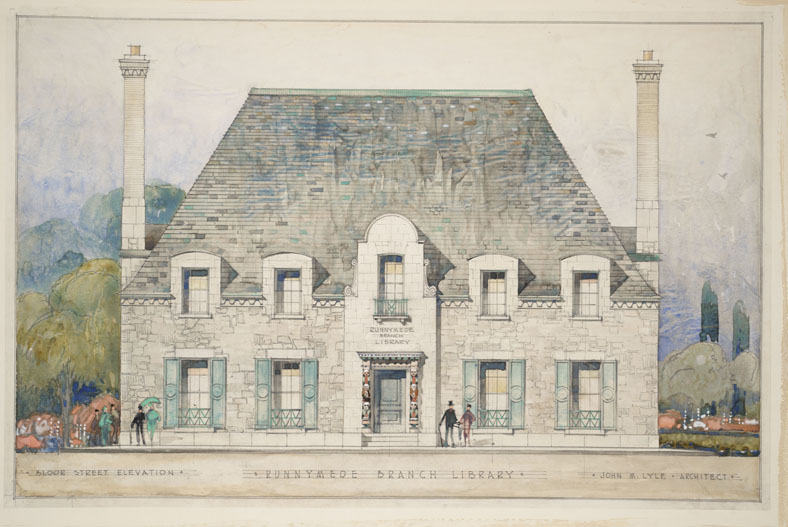
Runnymede Branch opens. (See an early rendering.)
Central Circulating Library is added to the Central Library on College Street.
-
1931

Edith Mary Davidson and the TPL Board Edith Mary Davidson is appointed the first woman chair of the Toronto Public Library Board, a position she also holds in 1936 and 1942.
-
1939

Military Camp Library, 1939 Military Camp Library is established at Exhibition Place for the troops in training there.
-
1943

First Leaside Public Library, 645 Bayview Avenue, 1945 An association public library is organized in Leaside, and opens a library in rented quarters at 645 (now 1645) Bayview Avenue. The Leaside Public Library Board, formed in 1944, opens a library at 165 McRae Drive in 1950.
-
1944

Charles R. Sanderson, Chief Librarian, at the opening of East York children's library, 1945 A children's library opens in R. H. McGregor School, East York on November 7, 1944. The Township of East York Public Library Board is established in 1946, opening a library at the northeast corner of Coxwell and Mortimer avenues in 1950.
-
1945
Township of York Public Library Board is formed, taking over the assets of the Mount Dennis Library, which operated a small branch in rented quarters above a store. On September 9, 1946, a second branch is opened in rented quarters at the corner of Oakwood Avenue and Vaughan Road. In February 1948, it inaugurates the first bookmobile service in Toronto area. A Main Library on Eglinton West at Northcliffe, and two new branches, Jane Street and Mount Dennis, open in 1951.
-
1946

Crowd gathered outside the Long Branch Public Library. Long Branch Public Library Board holds its first meeting on January 22. In 1955, it opens its own library building on Lake Shore Boulevard.
-
1949

Edgar Osborne and the Osborne Collection of Early Children's Books The Osborne Collection of Early Children's Books is presented to the Toronto Public Library Board by Edgar Osborne; the collection spans English children's literature from the 15th century to 1910.
George H. Locke Memorial Branch opens, Toronto Public Library's first new branch since the Depression and the Second World War. It is named for Toronto Public Library's chief librarian, 1908–1937.
-
1950s

Deer Park Branch, 1952 Two new branch buildings open in Toronto: Deer Park (1952) and Parliament Street (1955).
-
1950

Etobicoke Public Library bookmobile, about 1953 Township of Etobicoke Public Library Board is established. During the 1950s, when Etobicoke's population tripled, branch libraries are opened at Humber Bay (1951), Brentwood (1955) Alderwood (1958) and Rexdale (1959), while a bookmobile serves many neighbourhoods.
North York Public Library opens on the ground floor of the new North York Memorial Community Hall, Yonge Street, south of Park Home Avenue. By 1997 it has grown into a system of 19 library locations, providing a tiered model of service with a central library, and regional and satellite branches.
-
1954

Construction of new Forest Hill Village Library and Municipal Building, 1962 Forest Hill Public Library Board is established, with assets transferred from an earlier association library. A new library opens in the village's municipal building built in 1962.
-
1955

Scarborough Public Library bookmobile, 1956 Scarborough Public Library Board is established, bringing together the Agincourt, Highland Creek and Scarboro library associations, and opening the Golden Mile Branch in 1956. By 1997, it has developed into a system of 19 libraries including neighbourhood and community branches, and three district libraries.
-
1960s

Don Mills Branch, North York Public Library, approximately 1961 Twenty-four new branches open in Metropolitan Toronto: Jones (1962), Parkdale (1964), City Hall (1965) and Charles R. Sanderson (1968) in Toronto; Eatonville (1964) and Albion Mall (1965) in Etobicoke; Evelyn Gregory (1968) in York; McGregor Park (1960), Bendale (1961), Taylor Memorial (1962), Cedarbrae (1965) and Morningside (1968) in Scarborough; S. Walter Stewart (1960) and Todmorden (1961) in East York; Don Mills (1961), Bathurst Heights (1962), Downsview (1963), Woodview Park (1964), Bayview (1966) Centennial (1966), Amesbury Park (1967), Victoria Village (1967), Black Creek (1968) and Brookbanks (1968) in North York. In addition, the old Carnegie library at Mimico is replaced with the Mimico Centennial Library.
-
1965

Issue #1 of Young Voices, 1965 Young Voices, a magazine of teen writing and artwork, is first published by North York Public Library. The magazine has been published continuously ever since.
City Hall Branch opens in Toronto's new city hall. As well as a circulating library it houses a business and municipal reference collection.
-
1967

Logos for Toronto Public Library (top left), York Public Libraries (top right), East York Public Library (middle left), Metropolitan Toronto Library Board (middle right) and Etobicoke Public Library (bottom) Public library boards at Forest Hill (established 1954) and Swansea (established 1923) are amalgamated with Toronto Public Library Board, when their municipalities became part of the City of Toronto.
Borough of York Public Library is formed bringing together library facilities from York Township and the Town of Weston; by 1997 it had six branches.
Township of East York and the Town of Leaside are amalgamated to form the Borough of East York. The East York Public Library Board is established, amalgamating the public library boards of the former Township of East York (established 1946) and the Town of Leaside (established 1944). By 1997 it had five branches.
With the amalgamation of the Township of Etobicoke with the towns of Mimico, New Toronto and Long Branch, the Etobicoke Public Library Board is formed. Its ten branches increases to 13 by 1997.
Metropolitan Toronto Library Board is established. The Central Library collections and other special collections were transferred from the Toronto Public Library to the new Metro Board.
-
1970s

Fairview Branch, 1976 Eighteen new branches are opened in Metropolitan Toronto: Palmerston (1971), Northern District (1975), Spadina Road (1977), Perth/Dupont (1977) and Queen/Saulter (1979) in Toronto; Albert Campbell (1971), Cliffcrest (1972), Guildwood (1974), Port Union (1974), Bridlewood (1976) and Woodside Square (1977) in Scarborough; Thorncliffe Park (1970) in East York; York Woods (1970), Fairview (1972), Humber Summit (1974), Hillcrest (1975), Pleasant View (1975) and Flemingdon Park (1978) in North York.
-
1970

Judith Merrril in the Spaced Out Library, 1975 Judith Merril donates her collection to Toronto Public Library, the beginning of the Spaced Out Library — now the Merril Collection of Science Fiction, Speculation and Fantasy.
Shut-in Service (now Home Library Service) is inaugurated at Toronto Public Library, and in Etobicoke in 1971.
-
1973

Rita Cox at Parkdale Branch Black Heritage and West Indian Resource Collection is pioneered by Rita Cox, esteemed librarian and admired leader in the Black and Caribbean community. The collection later becomes the Rita Cox Black and Caribbean Heritage Collection — now held at Malvern, Maria A. Shchuka, Parkdale and York Woods branches.
-
1977

Toronto Reference Library, 1977 The Metropolitan Toronto Reference Library (now known as Toronto Reference Library) opens at 789 Yonge Street. It replaces the Central Library on College Street.
Spadina Road Branch opens, housing the Native Peoples Collection. The collection was established by the Indigenous community as part of the Native Library and Reference Centre within the Native Canadian Centre (opened 1976). The library branch was opened by the Native Canadian Centre in partnership with Toronto Public Library — and purchased by the Library in 1980.
-
1980s

St. Clair/Silverthorn Branch, 1981 Twelve new branches are opened in Metropolitan Toronto: St. Clair/Silverthorn (1981),,St. Lawrence (1982), College/Shaw (1984), Davenport (1988) and Danforth/Coxwell (1989),in Toronto; Malvern (1982), Maryvale (1982), Steeles (1987) and Kennedy/Eglinton (1988), in Scarborough; Armour Heights (1982) and Jane Sheppard (1989) in North York; and Elmbrook Park (1988) in Etobicoke. In addition, North York Central Library opens in a new facility in 1987.
-
1987
The HUB, a place “geared towards the recreation and popular information needs of the teen,” opens on the first floor of the new North York Central Library. The space includes four jukeboxes, TV monitors for watching MuchMusic, fiction and magazines.
-
1990s

Oakwood Village Branch, 1997 Four new branches are opened in Metropolitan Toronto before amalgamation: Goldhawk Park (1992) in Scarborough; Northern Elms (1991) and Humberwood (1996) in Etobicoke; and Oakwood Village (1997) in York. In addition, several branches are replaced or renovated.
-
1991

Kyle Rae, the first openly gay Toronto city councilor, helped establish the collection The Gay and Lesbian Collection, with 600+ initial titles, debuts at Northern District Branch in time for Toronto's first officially recognized Gay Pride Day. The collection, now known as The Pride Collection, moved to Yorkville Branch in 1996 and is now the largest circulating 2SLGBTQ+ collection in Canada.
-
1997
The City of Toronto Act (Bill 103) is passed by the Ontario Legislature, amalgamating the seven existing municipal governments of Metropolitan Toronto.
-
1998

Toronto Public Library logo Seven library boards in Metropolitan Toronto are united into one library called the Toronto Public Library. With 97 locations, it is the largest public library system in North America serving a population of 2.3 million.
Josephine Bryant is appointed as the first City Librarian of the newly-amalgamated Toronto Public Library.
Burrows Hall is the first branch opened by the new Toronto Public Library Board.
-
1999

Original logo for Virtual Reference Library Integrated online catalogue of the Library's collections is completed, giving unified access to nine million books, magazines, CDs, CD-ROMs and other materials in a hundred different languages.
Virtual Reference Library is launched, providing online access to information on key subject areas through a series of gateways, digitized collections and research databases.
-
2000s

Jane/Sheppard Branch rendering Five branches reopen after relocation and reconstruction: Leaside (2002), Morningside (2006), Woodside Square (2007), Cliffcrest (2008) and Jane/Sheppard (2009). Eleven more branches officially reopen after extensive renovations: Beaches (2005), Malvern (2005), Northern Elms (2005), Runnymede (2005), Long Branch (2005), Pape/Danforth (2006), Jane/Dundas (2008), S. Walter Stewart (2008), Dufferin/St. Clair (2008), Kennedy/Eglinton (2009) and Bloor/Gladstone (2009).
-
2000

Computer Learning Centre, Riverdale Branch, 1997 Installation of more than 400 internet workstations acquired through a grant from the Bill and Melinda Gates Foundation.
First strategic plan of the amalgamated Toronto Public Library is prepared to guide the library into the new millennium.
-
2003

ALA Toronto Logo Toronto Public Library hosts the American Library Association Conference, June 19–25.
-
2004

St. James Town Branch, 2004 St. James Town, Toronto Public Library's 98th branch, opens.
Toronto Public Library launches its second strategic plan for 2004-2007: Urban Stories: The Next Chapter.
-
2008

Cover of third strategic plan, 2008 Jane Pyper is appointed as the new City Librarian on September 2.
Toronto Public Library publishes its third strategic plan since city amalgamation for 2008-2011, Our Shared Stories.
-
2009

Panel in the Bram and Bluma Appel Salon Bram and Bluma Appel Salon, a premier event space for Toronto Public Library's cultural and heritage programming, is opened in
Toronto Reference Library.Toronto Public Library Foundation launches a five-year, $34 million revitalization of the Toronto Reference Library.
-
2010s

Cedarbrae Branch, 2010 Eight branches reopen after major renovations and expansions: Thorncliffe (2010) and Cedarbrae (2010), Brentwood (2012), Mount Dennis (2013), Agincourt, Albion (2017), Eglinton Square (2017) and Humber Summit (2018).
-
2010

Fourth strategic plan The first Newcomer Hubs for teens open at Centennial and Sanderson branches. These drop-in spaces are later renamed Youth Hubs and are places for teens to study, chat with friends, use technology, connect with staff or take part in activities such as arts and crafts and gaming.
Toronto Public Library publishes its fourth strategic plan, 2012-2015 Read. Learn. Create.
-
2011

New entrance at Toronto Reference Library Urban Affairs collections and services are relocated to Toronto Reference Library and a new glass entrance cube opens as part of the building's five-year revitalization.
-
2014

IBBY Collection, 2019 Fort York, Toronto Public Library's 99th branch opens.
IBBY Collection for Young People with Disabilities opens at North York Central Library.
-
2015

Scarborough Civic Centre, 2015 Toronto Public Library opens its 100th branch, Scarborough Civic Centre.
Vickery Bowles is appointed Toronto Public Library's new City Librarian, January 5.
Toronto Star Newspapers Ltd. donates its photographic archive of more than one million press photographs from 1900–1999 to Toronto Public Library.
Toronto Public Library hosts its first Writer in Residence for Aboriginal Experience, Cherie Dimaline.
-
2016

Documents from the Chinese Canadian Archive Chinese Canadian Archive launches. The community-built archive reflects the rich history of Chinese Canadians in Toronto and the Greater Toronto Area.
Sun Life Financial Musical Instrument Lending Library opens and is the first of a kind in the city and the first in public libraries across Canada.
North York Central Library begins a five year renovation.
-
2018

Elders in Residence Frances Whiskeychan and Patrick Etherington Introduction of Land Acknowledgement Statements. Also launched: Read Indigenous and Elders in Residence programs. These initiatives follow the
inaugural meeting of TPL’s Indigenous Advisory Council and the endorsement of Strategies for Indigenous Initiatives in 2017 in response to the Truth and Reconciliation Commission’s 94 Calls to Action.The Youth Services Strategy is adopted. It provides staff with support and guidance to welcome youth into resource-rich environments where they can build positive futures for themselves and their communities.
-
2019

New TPL logo Toronto Public Library adopts a new visual identity and logo.
Online Card Renewal is launched, one of the most commonly requested customer service enhancements.
-
2020

Lillian H. Smith Branch entrance during COVID-19 pandemic, July 2020 COVID-19 pandemic forces the shut down of all 100 branches in March. The Library pivots services in response to the pandemic, adapting to new ways of serving Torontonians while keeping health and safety as the paramount priority. This includes introducing Digital Access Cards, increasing access to online resources and content, creating online programming and virtual learning, distributing internet connectivity kits and over 10,000 wellness calls to senior library customers aged 70+ and Home Library Service customers.
Toronto Public Library turns its spaces into food bank distribution centres, partnering with the North York Harvest Food Bank, Daily Bread Food Bank, and Second Harvest to set up 12 pop-up food banks between March and September. Distributes approximately 14,700 hampers serving over 42,300 people in need. Ellesmere distribution hub serves as location for food sorting and distribution.
More information on pandemic response: COVID-19 Impact Report – 2020 Year In Review (PDF)
Toronto Public Library launches its fifth strategic plan for 2020-2024, tpl: vital to toronto.
-
2022

Promotional announcement of elimination of late fines Toronto Public Library eliminates late fines for everyone, removing a barrier to access and making the library more welcoming to all Torontonians. It followed the elimination of children’s overdue fines in 2021.
Albert Campbell opens after major renovation. Wychwood reopens after renovation and new addition.


More library history
- Toronto's Carnegie Libraries
- History of Children's Services
- Lillian H. Smith (Head of Children's Services, 1912–1952)
- George H. Locke (Chief Librarian, 1908–1937)